



E60 M5 Review – Never Before, Never Again
When it comes to the E60 M5, the ‘M’ might as well stand for Marmite as much as it does Motorsport: right now this supersaloon sits in an odd space.
It’s not as celebrated as earlier M5s, nor does it offer the outright performance of the later cars. It has many technological firsts all of which date it to a period of time where the tech wasn’t yet at its best. Running costs are high and spare parts are starting to become scarce. It’s finickity, costly and showing its age. None of that matters though; this car is an absolute delight and somewhat of an underdog in M5 heritage.
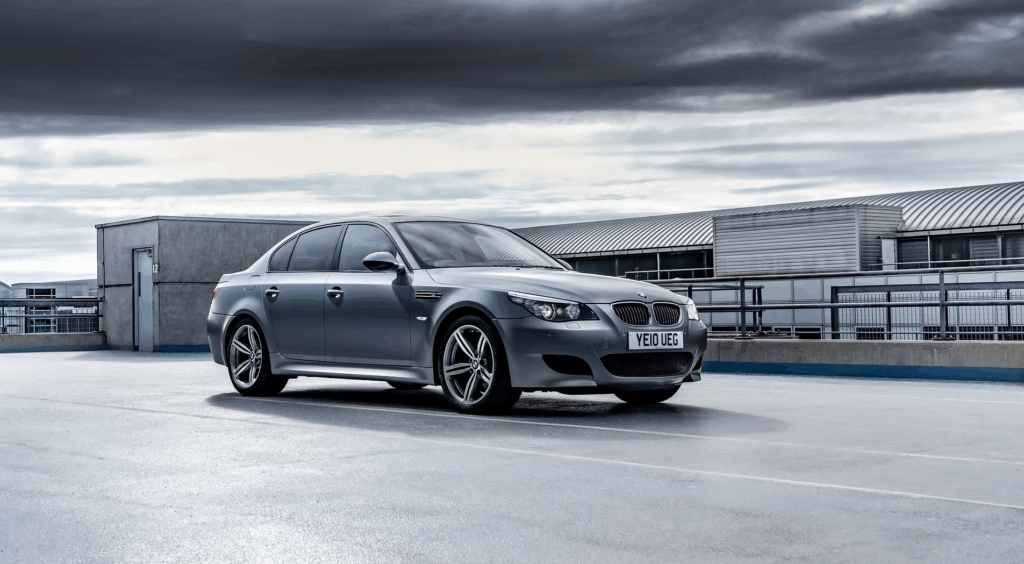
The E60 M5 is a car that the world will never see again. The decision to fit a V10 to an executive saloon was motivated by BMW’s involvement with the Williams Formula One team. Unlike previous M cars where a regular production engine was sprinkled with a little ///Magic the E60 received something entirely different – the M division’s very first clean sheet design engine.
In essence you take some F1 knowhow, a lump of lightweight materials and a liberal view to economy and CO2 figures and you get the S85. 5.0 litres, 8250rpm and 507hp, but before we get there I can’t help but pause to admire the E60 platform.
The outside doesn’t look hugely different from a regular 5 series but you can see the subtle styling tweaks that hint at what this car might be. In the modern world where M cars are slap you round the face styled, the E60 maintains the wolf in sheep’s clothing mantra of earlier M5s. Bangle styling might not be for everyone, but it very much does it for me. Those 4 exhausts and rear three-quarter view is something to behold, a beautifully boiled Bratwurst of Bavarian Brilliance.

Inside, the cabin is a true representation of the BMW of old. High end materials, sports seats as epically comfortable as they are supportive and a proper steering wheel that isn’t designed for an orangutan to grip. You could spend hours in here and not once would you have an ache, pain or a searing sense of rage when you can’t find the volume control.
Being from the pre touch screen, proper buttons, and analogue dial era it really makes you miss what we used to have. The BMW i-drive, a bone of contention when introduced, is a doddle to operate – not once did I need a huge screen, haptic buttons or a holder for my knackers.
Enough eulogising about interiors though, it’s time to drive.
From the off the S85 is quick to respond to throttle inputs and has genuine low down grunt – contrary to every keyboard road tester’s opinion on the internet. The mid range is more of the same but I can start to sense the upcoming crescendo. By 6500rpm I’m riding a wave of harmonic delight that combines a razor sharp timbre with a creamy undertone.
Chase that to the 8250rpm redline and my god I can’t write what I’m thinking without being locked up or cancelled. You’ll need a cigarette afterwards is all I’ll say.
507hp might sound weedy in the modern turbo-hybrid era but in this car you don’t need any more, not once are you left wanting for more. The way the E60 M5 makes its power is genuinely exciting and chasing the redline is unforgettable.
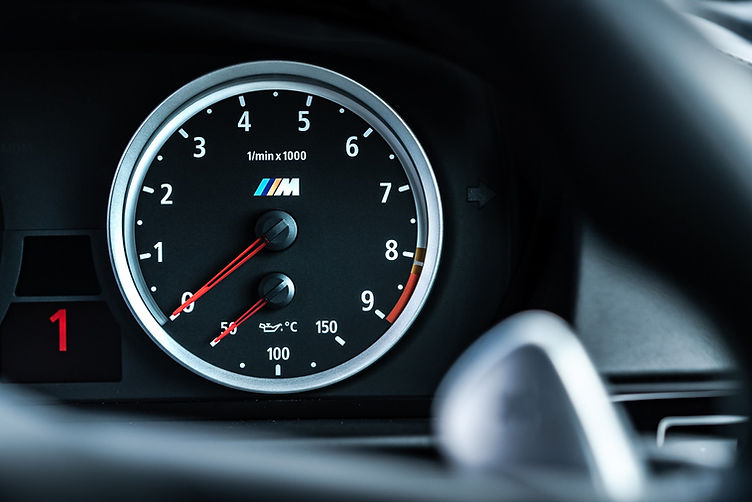
The S85 engine won’t ever be repeated and it’s a good job because the aural joy it offers is akin to a siren song. I’m already drawn to the classifieds clutching a box of rod bearings and a Shell reward card. It’s hypnotic and I’m fully under its spell; it’s a snorting angry German warthog reined in by a slightly surly semi-automated manual handler.
The SMG is a curious piece of engineering: a single clutch under the control of a robot that works all the difficult bits of a manual, with the care and attention of a teenage rollercoaster operator. Most will tell you it’s jerky, uncouth and terribly outdated.
The truth is, it was at the time when the E60 was brand new and was expected to perform daily duties and demolish continents, but nowadays this car is a strict weekend toy. Spend 5 minutes learning how to work with it and you will have a gearbox which is just as satisfying to use as a manual. Yes, really.
You have to first set yourself up for success, put everything into full kill, set the shift aggression to max (80ms per change) and the gearbox to manual. Around town a small lift of throttle on upshifts will result in a shift that just glides in. When going down the gears a little blip will help slot that down change in and it’ll almost be imperceptible. Gone are the shudders and slams you’d usually get when leaving the gearbox to its own devices.


This car isn’t about shunting though, it’s about wide open throttle, so how do you play the SMG fiddle then?
It’s more of the same only your actions need to be quicker and better timed. Snap from full throttle to no throttle just as you pull the paddle (or channel your inner DTM driver and tug the lever) and the upshift hits but it doesn’t hurt. A bigger prod on downshifts and the gear will take with a flurry of revs just like a well-timed heel-and-toe in a three pedal car.
All of this might sound dreadful but it just isn’t. This engine and gearbox combo manages to create engagement and fun, you relish the opportunity to learn how best to operate it and when it all goes well it becomes endearing. Left foot braking and blipping the throttle becomes second nature and you want to treat it well because you know that it’ll treat you well. It encourages personal growth and teaches you that patience and kindness apply to all walks of life, even the 5.0 V10 ones.
Where BMW M’s Midas touch is really felt is in the character of the car. It’s enjoyable at low speeds where you flow with the chassis and can enjoy brief dances into the rev range. As you start to pick up speed you’ll feel the car hunker down and shift to a more focused attitude. Some of this comes from all the buttons and modes available, but even without those you know this car was developed by people who care.
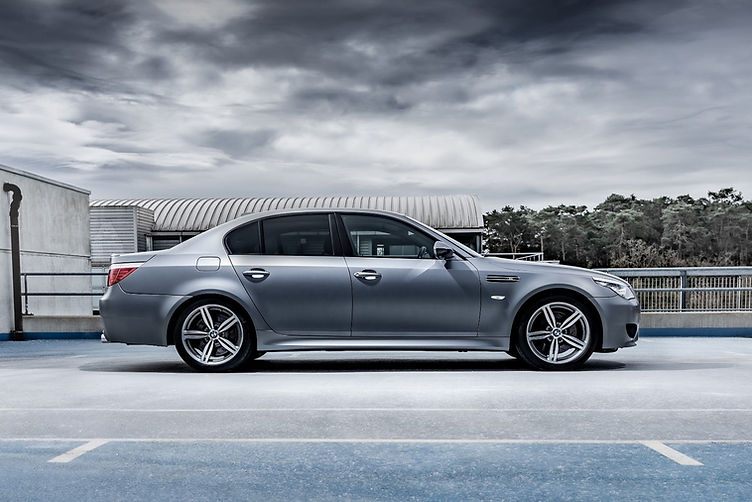
Chassis balance is spot on, with that BMW hallmark 50:50 weight distribution. It doesn’t drive like any other BMW though; it has that M edge. This can be a little firm in its stiffest setting but that’s worth the trade-off for the body control and confidence you get. It feels like a big M3, or to some extent a really big MX-5. Much in the same way you can feel the lightness in an MX-5s steering, in the M5 you can feel its weight but don’t mistake that for heft. It’s solid and robust but with a dynamic flair.
Steering is hydraulic and that really is something that we miss. Sure this rack isn’t one of the greats, but it gives you a sense of connection. There’s smoothness to how it weights up and unweights. You have no issues in loading the front axle into a turn as it tells you exactly what is going on. By corner exit you’ll feel the weight shift rearwards, a little lightness comes to the steering letting you know that it’s ok to squeeze the throttle. There’s no blurred lines here, you can just get on with it without the unknown that comes from some modern EPAS racks.
The V10 really suits the chassis, with a smooth and linear power delivery helping you to get into a rhythm. You wouldn’t believe that 2nd gear corners can be exited at full throttle but they can. I have no doubt that with the traction off you could pull some outrageously huge slides but you don’t have to drive in that manner for this car to come alive.


It’s not all sweetness and light however, some elements of this car do wear. Stop start traffic is not a happy place, the SMG doesn’t creep when you let off the brake so instead you push a bit of throttle and… thunk! There’s the gear and a lurch forward to go with it. Manoeuvring is a carefully balanced art of just the right amount of throttle and some patience and you jump between first and Reverse. Speedy three point turns are a no no.
It’s also thirsty. By god can it drink; 9mpg average and chewing 50 miles of range across 10 miles of distance is a new personal record even for me. I won’t mention the well documented reliability and general running concerns, we’ve all read the pages and pages of internet forums. The reality is that if you want a 200mph V10 saloon with a motorsport derived engine you have to be willing to plunder your savings account. Paying the cost to be the boss springs to mind.
The engine alone is enough to make this one of the greats, combine that with a chassis that flatters its powertrain and a gearbox that somehow adds to the experience and you have one hell of a car. I’m a fully paid up member of the E60 M5 club and don’t you dare say the SMG is bad, you just can’t drive properly. Take the time to learn this car and it will be a truly fantastic experience, it will probably go wrong at some point though, but that’s life isn’t it?
BMW E60 M5 Vital Statistics:
Performance Figures
| 0–62mph: 4.7sec | Quarter-mile: 12.8sec @ 117mph |
| 0–100mph: 9.5sec | 50–75mph (4th gear): 4.1sec |
| 0–124mph: 13.6sec | Top speed (limited): 155mph |
| 0–150mph: 23.0sec | Top speed (de-restricted): 205mph |
S85 Engine Specs
| Engine | 5.0-litre V10 (S85) |
| Configuration | 90° V10, DOHC, 40 valves |
| Displacement | 4,999cc |
| Bore x Stroke | 92.0 mm × 75.2 mm |
| Compression Ratio | 12.0:1 |
| Max Power | 507bhp @ 7,750rpm |
| Max Torque | 520Nm @ 6,100rpm |
| Redline | 8,250rpm |
SMG III Transmission
| Gearbox | 7-speed automated manual |
| Final Drive Ratio | 3.62:1 |
| Drive Type | Rear-wheel drive |
Suspension, Brakes & Steering
| Steering | Hydraulic power-assisted rack and pinion |
| Front Suspension | Double-joint tension rod spring-strut |
| Rear Suspension | Aluminium integral multi-link axle |
| Brakes (Front) | 374mm ventilated & drilled discs, twin-piston calipers |
| Brakes (Rear) | 370mm ventilated & drilled discs, single-piston calipers |
| Wheels (Front) | 8.5J x 19″ alloy |
| Wheels (Rear) | 9.5J x 19″ alloy |
| Tyres (Front) | 255/40 ZR19 |
| Tyres (Rear) | 285/35 ZR19 |
Vehicle Weight
| Kerb Weight | 1,830kg |
| Power to weight ratio | 277bhp per tonne |
| Torque to weight ratio | 210lb ft. per tonne |
Battle of the Audi RS4 Generations: Group Test Review of the B5, B7, and B8

Few cars offer as much space and pace as Audi’s omnipotent RS4. But with prices of the first three generations now within touching distance of each other, which is the one to drive, and which is the best to buy? A throwback to one of our first articles, “The Space Race” was captured in some very trying conditions. In other words, perfect RS4 weather.
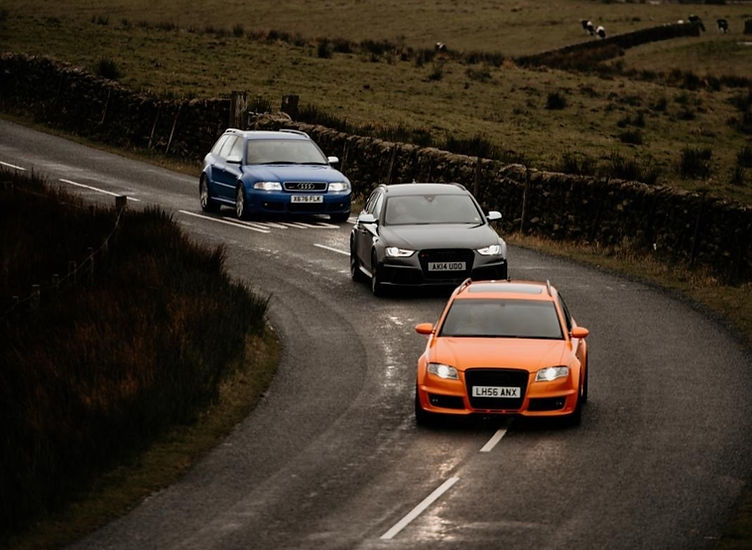
Rain. Sometimes it’s therapeutic, often cathartic, but today it’s downright maddening. The clouds above have gone through fifty shades of grey, delivering everything from fine drizzle to Hard Rain. Only Ben, our photographer, rivals the persistence of the precipitation, but even he’s beginning to lose all feeling in his fingers.
You might think these are the days when a Quattro-equipped Audi would shine, but right now, we’re half-expecting Noah’s Ark to pass on the inside. Tread depth and bravery have become the key measures of performance, not bhp and lateral G. Still, most performance cars would have long packed up and gone home. But who are we to deny a couple of V8s and a pair of turbochargers a chance to sing in the rain?

The origin of the high-performance estate is up for debate, but few manufacturers have cornered the market like Audi. Volvo made a strong bid in the mid-nineties with the T5R, but for all its image-redefining touring car chic, it never troubled the rear view mirror of an RS2 – the turbocharged uber-wagon that laid the template for the RS4. The RS2 famously outpaced a McLaren F1 – to 30mph, at least. The RS badge then migrated to the A4 Avant and later the RS6, but the ability to humble supercars remained. Just as the dictionary says ‘see BMW M5’ under the definition of a super saloon, Vorsprung Durch Technik is synonymous with plastering the family hound to the back window.
The RS2, born in 1994, was the offspring of a joint venture between Audi and Porsche. Audi provided the donor S2 Avant, while Porsche stamped its mark on the brakes, chassis and power delivery. Open the bonnet of an RS2 and you’re greeted not by Audi’s four rings, but by Porsche’s iconic typeface. Porsche’s engineers were justifiably proud of extracting 315 bhp from the S2’s turbocharged 2.2-litre inline-five – a 50% increase, thanks to a bigger KKK turbo, new intercooler, uprated engine management, larger injectors, and a freer-flowing exhaust. To cope, the suspension was lowered by 40mm, and Porsche fitted its own 17” Cup alloys from the 964 Turbo, hiding four-piston Brembo callipers.

Porsche’s plastic surgeons gave the bodywork a subtle nip/tuck, adding a Carrera-inspired front bumper, wing mirrors, and an extended rear light strip. With a 0-60 time of just over four seconds and a top speed of 160mph, the RS2 was a hit. Audi initially planned for only 2,200 units, but demand pushed another 700 out of Porsche’s specialist Rossle-Bau factory. Pedigree doesn’t come much finer – both the Porsche 959 and Mercedes 500E came out of the same finishing school. Unfortunately, only 180 of those were right-hand drive, and their rarity today puts them well beyond the reach of Rush’s little black book.
The RennSport badge returned with the RS4 in 1999. This time, Audi’s in-house go-faster arm, Quattro GmbH, teamed up with a certain British concern by the name of Cosworth, to build a monster. Their goal? An Avant capable of humbling a Porsche 911. And if BMW’s M3 got in the way, it would just have to be steamrollered too.
Starting with the already-capable S4, which had a 2.7-litre, five-valve-per-cylinder twin-turbocharged V6 producing 265 bhp, Cosworth’s engineers went to work. They replaced the cylinder head with their own aluminium design featuring enlarged intake and exhaust ports, swapped the turbos for parallel Borg Warner K04s, and increased the intercooler capacity. Stronger connecting rods, dished pistons, a recalibrated ECU, and a bigger exhaust completed the transformation.

Audi conservatively rated the B5 at 375 bhp and 325 lb-ft of torque. But the Cosworth engine was so over-engineered and receptive to tuning that the B5 became Germany’s answer to the Nissan Skyline GTR. German aftermarket tuners had a field day, and today a standard B5 is as rare as an RS2. This particular example, pristine in Nogaro Blue, recently laid down a 500bhp marker on the rolling road.
Harnessing that power is the Torsen central differential, splitting torque 50:50 between the axles under normal conditions. Massive 14” discs with double-piston callipers deliver immense stopping power – an emergency stop from 60mph takes just 2.5 seconds. Refereeing the action are 255-section tyres on beautiful, if slightly bend-prone, 18” multi-spoke alloys.
The B5’s footprint is compact by today’s standards, but it exudes discreet menace. The front air valances, rear arches, and wider track give it an unmistakably purposeful stance. At the rear, the chunky bumper visually lowers the car, while perfectly-proportioned twin oval exhausts jut out just-so.

Inside, the design is typically Germanic – dark, sober, and uber funktionell. The plush Recaro bucket seats with embossed RS4 emblems and glossy carbon fibre dashboard inserts add some much needed personality, elevating the ambience over regular A4s. Slim A-pillars and a large glasshouse means visibility is excellent, and a quick glance over the shoulder confirms the load capacity is certainly generous enough for plenty of sports car drivers ego’s.
Contemporary road tests weren’t as favourable to the B5 as they were the E46 M3 and 996 Porsche 911, citing a lack of ultimate body control and a brittle ride at odds with one another. These smaller rivals were more responsive and fleeter of foot, but here’s the rub – despite its obvious flaws, the B5 is one of those cars that gets right under your skin. Its laggy turbo delivery – no doubt exaggerated by this modified example – gives it an old-school charm, where the lack of linear throttle response is easily forgotten as your adrenaline spikes in tandem with the boost pressure. Assuming you’re north of 3,000rpm, it doesn’t matter what gear you’re in, the V6 answers and the pull doesn’t stop until the 7,000rpm limiter.
Yes, the rear axle squats comically under acceleration, the front dives under braking, and the tyres lean too hard on their sidewalls as the body rolls during hard cornering, but you can press-on safe in the knowledge that the Quattro system has your back.

Cornering the B5 is all about managing entry speed – the chassis is too surefooted for playfulness, though the steering offers more feedback than the armchair critic might suggest – it might not be geared for instantaneous turn-in, but there is genuine feedback in play. The brakes are harder to modulate, almost as if eighty percent of retardation is offered within the first couple of inches of travel, and the six speed manual serves up a knotchy throw that isn’t helped by the stubby gearlever. This lack of harmony across the controls proves to be the bigger bugbear of driving the B5 hard than any shortcomings of its chassis.
Of our trio, the B5 feels closer in character to the RS2 than its successors. But that doesn’t mean it’s antiquated. On the contrary, it feels alive at saner speeds on the public road, at a pace at which modern performance cars are still cosseting and isolating their occupants. With the B5, Audi cemented its reputation for building turbocharged, supercar-humbling estates. Yet there was no immediate successor. The RS4 badge skipped the B6 generation entirely, leaving a four-year gap that saw Audi rethink its formula. When the RS4 finally returned, it came back with a bold shift in philosophy – gone was the turbocharged surge, replaced by a high-revving, naturally aspirated V8.

Stealing M Division’s thunder, the 4.2-litre quad cam V8 developed its 414bhp at a spine-tingling 8,250rpm. The engine was so good, it later went on to power Audi’s first mid-engined sportscar, the R8. Further tweaks brought the B7 into closer alignment with the M3; the Quattro system was adjusted to favour the rear axle, sending sixty percent of power aft, and the front wings were now fashioned from aluminium to reduce weight over the nose, improving turn-in. With a slick manual gearbox, discreetly flared arches and surprisingly talkative steering, the B7 RS4 had morphed from a turbocharged bruiser to a precision instrument, burning off wooden handling Audi stereotypes faster than it sprinted from 0-60mph.
I’ve had extensive previous exposure to the B7, but as I drop into the driver’s seat I don’t recall it being mounted so low. Nor do I recall the embrace from the wingback Recaro clamping my waist tight enough to have me thinking cancelling that gym membership was a bad idea. The flat bottom wheel looted from the Lamborghini Gallardo looks fantastic with its perforated leather. The same material is carried over to the stubby gear lever, whilst the aluminium effect pedals are perfectly spaced. With its minimalist design, flashes of carbon and dials backlit in red it’s a classy interior that instantly makes the B5 feel the two generations older it is.
But the real step up in the B7 is in the driving – it takes all of fifty yards to know the B7 is a significantly different prospect from what came before. Where you feel your way into the B5, building up the pace, in the B7 you’re already eager to press on and it’s a key difference. You notice it first in the powertrain, which has none of the slack present in the B5. Throttle response is instantaneous and the clutch is lighter whilst the wonderful gear change slots home ratios with slick, oily precision. Then there is the damping – it’s firm at low speed but never jarring, taking on a wonderful fluidity with speed as it smooths off the harshest imperfections in the road, yet always maintains rock-solid body control. It should be stated that owner Mark has fitted some KW coilovers in place of the notoriously leaky and expensive DRC suspension, but it’s a sweetly judged, OEM+ package.
The steering has less initial weight than the B5 but loads more naturally. Confidence floods back into your forearms from the perfectly judged gearing, and you soon completely trust the car to go exactly where you tell it to when you tell it to. There is certainly more finesse and precision to the way the B7 handles, and come to think of it – stops, courtesy of this cars’ ultra-rare optional carbon-ceramic brakes. And that’s before I press the Sport button, which brings the additional benefits of an even sharper throttle and even more wind knocked out of me as the side bolsters inflate. It also opens the valves in the aftermarket Milltek stainless steel exhaust due to some cheeky coding by Mark.
Acceleration is an altogether different topic. Jump straight from the five into the seven and you’ll immediately ask where all the power has gone. It’s still there, this particular B5 has just warped your perception of speed. But it’s also twisted your perception of shift points. At 5,000rpm in the B5, you’ll be considering another gear, content to bask in the absolute mountain of torque, whereas the B7 will just be getting into its stride. The V8 thrives on revs and Mark tells me the more time spent above that marker is a good thing, his official line being it helps to prevent the known carbon build-up issue – as if I needed more encouragement to venture north of 8,000rpm. Wind the B7 up to its redline and you’ll have no doubt it’s a genuine 170mph car, sans limiter.
Mark’s smitten with the B7. ‘Next year I’m taking it to the Nürburgring to experience its full potential, where those carbon ceramics should come in handy. You’ll never find me complaining about this car no matter how much of my money it demands. The spec made this car irresistible – unique paintwork, double glazing, solar roof, and those wingback Recaros make it feel special even compared to most modern cars. In my opinion, the car still looks as good as most cars coming out of the factory today, but if you are interested in owning a B7 make sure you have deep pockets because the parts prices come at a premium.’

It’d be worth it though. The B7 remains a coveted car today and, after the R8, is arguably Audi’s greatest driver’s car – 20v UrQuattro included. It was even available as a saloon and a chunky cabriolet this time around, making the B7 the only RS4 to experiment with other body styles. However, neither holds the same cachet as the Avant, which remains the definitive RS4 silhouette.
Clearly, the B8 RS4 had a tough act to follow. Introduced in 2012, the B8 retained the same 4.2-litre V8 from the B7, but output increased to 444bhp. Torque remained at 317lb-ft, but crucially, it arrived 1,500rpm sooner – at 4,000rpm – and was sustained to 6,000rpm. Combined with the rapid-fire shifts of a 7-speed dual-clutch transmission, the B8’s straight-line performance was taken to another level – from standstill, the B8 RS4 will hit 100mph in just 9.4 seconds – rain or shine. But despite the boost in power, the driving experience, for many, felt like a step backwards.
In a reversion to type, Audi dropped the ball with the B8’s steering, swapping the acclaimed hydraulic assistance of B7 for an electro-mechanical setup, which, while improving efficiency, came at the expense of feel. The steering, too light and quick, stripped away a key layer of engagement, as did the loss of the manual gearbox. Audi had once again pivoted with its philosophy for the RS4, moving it away from the M3 and pitching it as more a junior RS6, more interested in crushing continents than the backroads of the Yorkshire Dales. The pivot can be partially explained by the introduction of the RS5 coupe, which now targeted the BMW.

That doesn’t mean Audi Sport didn’t put the effort in. As well as producing the goods, the V8 was mounted further back in the RS4’s chassis, although the bulk of its mass still resides ahead of the front axle. Nevertheless, it was enough to have a useful effect on the weight distribution, which had shifted from 60:40 in the B7 to 56:44, whilst the wheelbase grew by 162mm and the tyres swelled to 265 section all round, increasing grip and improving stability. Speaking of distribution, the Quattro system retained the B7’s 40:60 split in normal driving, but under duress, up to 70 percent of drive can go to the front or 85 percent to the rear. The system also gained a crown gear centre differential with selectable drive modes and torque vectoring.
The B8 also offered far more than the rudimentary Sport button of the B7. Calibration options extended to the gearbox, steering, dampers, exhaust, and throttle mapping. Thankfully, owner Rich is on hand to navigate the labyrinth, settling on comfort steering, auto damping, and dynamic settings for the throttle, differential, and exhaust, with the gearbox in full manual.

Even set up as such, the B8 can’t fully let go of its inhibitions. The speed is massive – too quick for the B7 along the straights, too grippy for the B5 in the corners – but it remains far too civilised producing it and the steering too inert, there is little sense of connection to the road, or of the limit of adhesion. The wide track, lack of roll and artificially quick steering do mean you can chuck the B8 into low-speed corners and direction changes with the same abandon as the B7, but outright pace is the only reward.
The tune coming out of those fat, signature oval pipes also remains slightly too subdued for our liking, but to be fair, we must remember today’s B7 has an aftermarket system fitted. The response to even minor throttle applications however, is deeply impressive – it’s a shame this derivative of the V8 never found its way into the R8 alongside the V10.
The brakes – eight-piston callipers & 365mm discs up front – are another talking point, but thankfully not down to their performance, which is impeccable. The curiosity comes from the unique flower petal design of the discs in order to better dissipate heat. Beware, however, their wavy circumference means a £2,000 bill come renewal time. Suddenly the £6,000 factory carbon ceramics don’t look so pricey.

As a pure driver’s car, it’s plain to see the B8 falls short. But that doesn’t mean all is lost. The B8 is comfortably the most comfortable car here, the build quality is vault tight and the interior is a wonderful place from which to while away the miles. There is a subtle, timeless elegance to the exterior design that gives the B8 a slow-burn ownership prospect appeal, one that would sit perfectly in a two car garage with something more exciting to drive on the weekends.
Audi has recently confirmed the current B9 generation RS4 will be the last. The outgoing model has seen the RS4 come full circle, returning to a 90 degree, twin-turbocharged V6 – a unit borrowed from none other than Porsche. This time the capacity is 2.9 litres and whilst the headline bhp is only up a fraction to 450, the torque has multiplied to 442lb-ft. Thanks to the blowers, the B9 makes its numbers over a much greater duration of the rev range, meaning acceleration has taken another quantum leap forwards. With its fast-acting ZF 8 speed automatic, the RS4 is comfortably sub-four seconds to 60mph, yet is capable of over 30mpg, two statistics the V8 cars can only dream of.

Disappointingly, we had a very special B9 RSR lined up to take part today, but Covid-19 quarantine restrictions intervened. Rest assured we’ll bring the car to these pages in the near future. Until then, which is our favourite RS4?
By any tactile measure the B7 is the undisputed winner. It’s an Audi that legitimately went toe to toe against the M Division with the added benefits of 24/7 any-weather security, Avant practicality and an engine that wouldn’t disgrace a Ferrari. It is exactly what an RS4 should be – practical performance and dynamic engagement rolled into a single package.
However, once the rain clouds have cleared and the feeling has returned to snapper Ben’s fingers, it’s the B5 that lingers longest in the memory. If the B8 is the GT and the B7 the communicator, the B5 is the beast. The original RS4 just has a greater sense of mischief about it that keeps you coming back for more, a turbocharged charisma that isn’t solely down to the adrenaline fuelled 500bhp performance of this example. Or perhaps, in this case, absolute power does corrupt absolutely.
Engine Specifications and Power Outputs
| Specification | B5 RS4 Avant | B7 RS4 Avant | B8 RS4 Avant |
| Engine Type | 2.7L V6 Biturbo | 4.2L V8 Naturally Aspirated | 4.2L V8 Naturally Aspirated |
| Power Output | 380bhp @ 7,000rpm | 420bhp @ 7,800rpm | 444bhp @ 8,250rpm |
| Torque | 440Nm @ 6,000rpm | 430Nm @ 5,500rpm | 430Nm @ 4,000–6,000rpm |
Performance Statistics
| Metric | B5 RS4 Avant | B7 RS4 Avant | B8 RS4 Avant |
| 0–60mph | 4.7 seconds | 4.7 seconds | 4.7 seconds |
| 0–100mph | 11.3 seconds | 11.4 seconds | 11.4 seconds |
| Top Speed (lim.) | 155mph | 155mph | 155mph |
| 1/4 Mile Time | 13.2 seconds (108mph) | 13.0 seconds (109mph) | 12.9 seconds (110mph) |
Transmission and Drivetrain
| Specification | B5 RS4 Avant | B7 RS4 Avant | B8 RS4 Avant |
| Transmission | 6-speed manual | 6-speed manual | 7-speed S-Tronic dual-clutch |
| Drivetrain | Quattro AWD | Quattro AWD | Quattro AWD |
| Torque Split | 50:50:00 | 40:60 (front:rear) | 40:60 (front:rear) |
Chassis Information
| Specification | B5 RS4 Avant | B7 RS4 Avant | B8 RS4 Avant |
| Front Suspension | Independent multi-link | Independent multi-link with DRC | Independent multi-link with DRC |
| Rear Suspension | Double wishbone | Independent multi-link with DRC | Independent multi-link with DRC |
| Front Brakes | 360mm ventilated discs | 365mm ventilated discs with 8-piston calipers | 365mm ventilated ‘wave’ discs with 6-piston calipers |
| Rear Brakes | 312mm ventilated discs | 324mm ventilated discs | 330mm ventilated ‘wave’ discs |
Weights and Ratios
| Specification | B5 RS4 Avant | B7 RS4 Avant | B8 RS4 Avant |
| Kerb Weight | 1,620kg | 1,650kg | 1,795kg |
| Power-to-Weight Ratio | 234bhp/tonne | 255bhp/tonne | 247bhp/tonne |
| Torque-to-Weight Ratio | 272Nm/tonne | 260Nm/tonne | 240Nm/tonne |
| Weight Distribution | 58% Front / 42% Rear | 58% Front / 42% Rear | 56% Front / 44% Rear |
Author

Craig Toone
Rush Founder
Photography by:
Ben Midlane, Isaac Hunter & Dan Hamilton
Published on:
16 September 2021
Our Print Magazine

CATEGORIES
LATEST ARTICLES

Porsche Rewrites its Product Strategy as EV Sales Falter
Craig Toone
|
26 September 2025

Max Verstappen set for 2026 Nürburgring 24 Hours with Red Bull backing
Craig Toone
|
25 September 2025

Zenos Rises from Administration with £140k E10 RZ
Craig Toone
|
24 September 2025
Subscribe to our newsletter
Email*Submit
Related Articles

Driven to Distraction:
Is the B7 Audi RS4 a Better Car Than the Fabled E39 M5?
Craig Toone
|
21 May 2024

Audi RS 4 Edition 25
Craig Toone
|
28 May 2024